Most mold conversations start at home. But some of the most significant mold problems we encounter at Ram Mold Pro are in commercial spaces — offices, schools, medical facilities, and multi-tenant buildings where the people inside spend forty or more hours a week breathing the air.
For employees who are sensitive to mold, that exposure is not a minor inconvenience. And for employers and property managers, understanding this issue is becoming more important as awareness of indoor air quality grows and employee wellbeing moves higher on the priority list.
Mold Sensitivity in the Workplace Is More Common Than Most Employers Realize
Mold sensitivity exists on a spectrum. Some people have no noticeable response to mold exposure even at elevated levels. Others — particularly those with existing allergies, asthma, or conditions that affect immune function — can experience significant symptoms from mold levels that would not affect most people in the same building.
This creates a situation that can be frustrating for everyone involved. An employee may report symptoms — persistent congestion, headaches, fatigue, eye irritation, or difficulty concentrating — that appear in the workplace and resolve over weekends or during time away. Other employees in the same space may feel nothing. Without understanding that mold sensitivity varies significantly from person to person, it is easy to misread what is happening.
According to OSHA, mold in the workplace is a recognized biological hazard, and employers have a general duty to provide a workplace free from recognized hazards that are causing or are likely to cause serious physical harm. While OSHA does not have a specific mold standard, this general duty clause has been applied to mold situations in commercial settings.
Why Commercial Buildings Are Particularly Vulnerable
Office buildings and commercial spaces face mold risk factors that are different from residential properties — and in some ways more challenging to manage.
HVAC systems in commercial buildings are larger, more complex, and serve more occupants. A mold problem that establishes inside ductwork, at an air handler, or on evaporator coil housing does not stay localized. The system distributes contaminated air throughout the building every time it runs. Because the HVAC infrastructure is largely hidden, this kind of contamination can persist for years without being identified.
Flat or low-slope roofing, common in commercial construction, creates more opportunities for water intrusion than residential pitched roofing. A slow roof leak into ceiling tiles or insulation above a drop ceiling can feed mold growth for months before it becomes visible. Meanwhile, the air circulating through that space is picking up spores continuously.
Older commercial building stock — which makes up a significant portion of the office space in Dayton and the Miami Valley — often has building envelope issues, deferred maintenance on mechanical systems, and less effective moisture control than newer construction. These are buildings where mold problems develop quietly and stay hidden.
Signs That a Commercial Building May Have a Mold Issue
Employers and property managers should pay attention to the following:
A persistent musty odor that is stronger in certain areas, around HVAC vents, or in spaces with less air circulation is a reliable early indicator. Musty odors in commercial buildings are often attributed to age or cleaning products — but mold should be on the differential.
Recurring moisture issues — roof leaks that were repaired but not fully dried out, condensation problems around windows or exterior walls, or any history of flooding — create conditions where mold establishes even after the visible water is gone.
A pattern of employee complaints concentrated in a specific area of the building, or complaints that consistently improve on days away from the office, is worth investigating rather than dismissing. The pattern matters more than any single complaint.
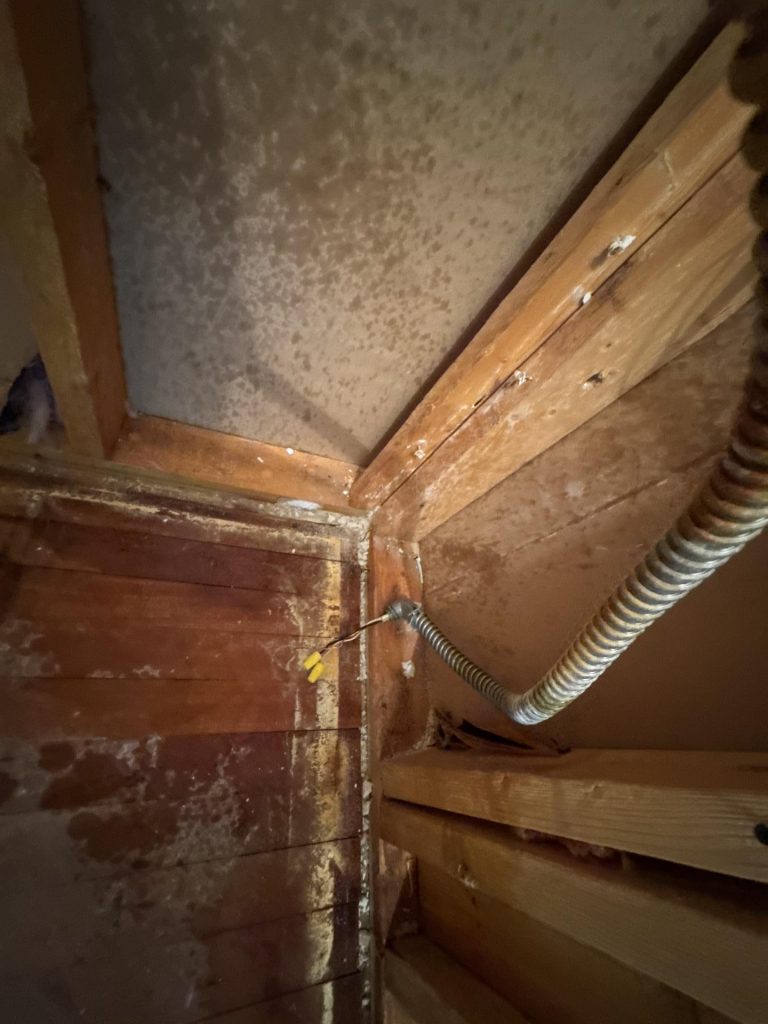
Visible staining on ceiling tiles, walls, or around windows, particularly in combinations of brown water staining and dark discoloration, warrants a professional look.
What a Commercial Mold Inspection Actually Involves
A professional mold inspection of a commercial space is not the same as a visual walkthrough. Ram Mold Pro’s commercial inspections include assessment of HVAC systems and air handlers, accessible wall cavities, roofline penetration points, ceiling plenum spaces where accessible, and any area with a documented or suspected moisture history.
Where warranted, air sampling can be used to establish a baseline of spore types and counts in the building relative to outdoor levels — which helps determine whether the building’s indoor air is contributing to occupant exposure beyond what would be expected from normal outdoor air.
The goal is not to find a reason to alarm employees or create operational disruption. The goal is to know what is actually in the building so that informed decisions can be made.
Protecting Employees Who Are More Sensitive
If you have an employee who has reported symptoms they connect to the workplace environment, the appropriate response is to take it seriously. Have the building inspected professionally. Provide documentation of the inspection results. If mold is found and remediated, document that process and the clearance testing that follows.
Beyond specific incidents, building managers can reduce mold risk proactively by maintaining HVAC systems on a regular schedule including coil cleaning, keeping building envelope inspections current, addressing any water intrusion within 24 to 48 hours rather than deferring repairs, and ensuring adequate ventilation in high-moisture areas like break rooms, restrooms, and server rooms.
None of this eliminates the possibility of mold. Commercial buildings are complex, and mold is opportunistic. But a proactive stance — including periodic professional inspections — is the most defensible position for any employer or property manager who takes occupant health seriously.
Ram Mold Pro Serves Commercial Properties Across Dayton and the Miami Valley
Ram Mold Pro handles commercial mold inspections and remediation for offices, schools, medical facilities, and multi-tenant commercial properties throughout Dayton, Kettering, Centerville, Beavercreek, West Chester, and the surrounding Miami Valley region. Our team is IICRC-certified and follows ANSI/IICRC S520 protocols on every commercial job.
If you manage a commercial property and have questions about mold risk or want to schedule an inspection, we are glad to have that conversation.
888-609-6653
www.rammoldpro.com