Fall in the Miami Valley isn’t a single event, it’s a gradual, measurable slide, and the National Weather Service’s own climate data for the Dayton area lays out that slide in specific numbers worth knowing, because each stage of it changes what’s actually happening to humidity inside a house, not just outside it.
Normal temperatures track a steady decline through the season: highs and lows around 82°F/60°F in early September give way to roughly 75°F/53°F by late September, then about 70°F/49°F in early October, dropping further to around 66.5°F/46°F by mid-October. The area’s normal first fall freeze, the first time temperatures hit 32°F, lands around October 25th, though the National Weather Service’s own data shows real variability, with an early-occurrence date around October 13th and a late-occurrence date as far out as November 7th.
What that gradual slide means indoors is the part worth paying attention to. As outdoor temperatures drop, most homes shift from occasional heating to a more consistent heating pattern, windows close for longer stretches, and the natural air exchange that happens more freely in warmer months tapers off. That’s the exact mechanism behind several of the seasonal moisture issues covered elsewhere on this blog: less air exchange means indoor humidity generated by daily living has fewer ways to leave, and a house that handled summer humidity fine can behave differently once this transition is underway.
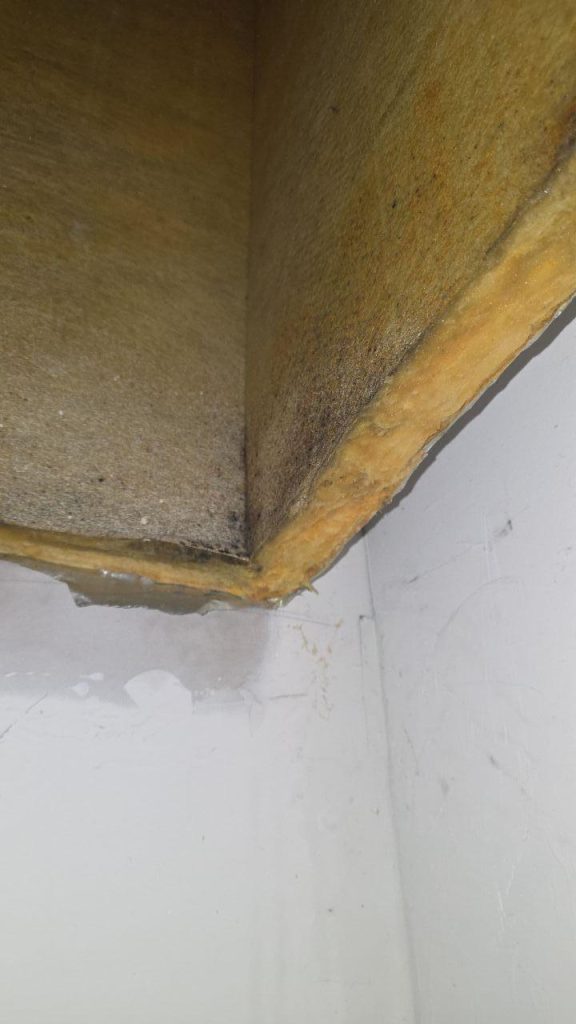
A question we hear often: does a specific calendar date actually matter, or is this all pretty gradual anyway? It’s genuinely gradual, and that’s part of the point, because a gradual shift is easy to miss precisely because there’s no single dramatic moment marking when conditions changed. A home doesn’t go from “fine” to “humid” on a specific day in mid-October. It drifts there over the weeks this data describes, which is exactly why the finding pictured here, staining along fiberglass insulation at a wall/ceiling corner, often develops during a slow seasonal transition like this one rather than from any single event a homeowner would remember.
The freeze-date variability is worth understanding too, not just the normal date itself. A season where the first freeze arrives closer to the early date, October 13th, compresses this transition into a shorter window. A season where it arrives closer to November 7th stretches it out. Either way, the underlying shift, less ventilation, more consistent heating, less natural humidity removal, is happening throughout that whole window, whether the calendar’s first frost technically arrives early or late in a given year.
None of this means every home is heading toward a problem. It means this specific stretch of the calendar, roughly mid-September through late October in this region, is the actual window during which the conditions behind several common seasonal moisture issues are quietly building. Paying attention to ventilation and humidity now, while that transition is underway, is simpler and cheaper than addressing what it can lead to once it’s fully visible.
If a room’s felt different since the weather turned, it’s worth a real look before it becomes obvious: 888-609-6653 or www.rammoldpro.com
Dealing with water, fire or storm damage? Contact our sister company, Ram Restoration, at www.ramrestorationusa.com/contact/
Related reading
- Does Closing Your Windows for the Season Quietly Raise Your Indoor Mold Risk?
- The Mold That Peaks Every June in Ohio — And Why Dayton Homes Are Especially Vulnerable Right Now
- What Happens to a House’s Humidity Once It’s Closed Up and Quiet?
- All Ram Mold Pro articles
FAQ’s
How do Dayton temperatures change in the fall?
Normal Dayton-area temperatures decline from roughly 82°F/60°F (highs/lows) in early September to about 66.5°F/46°F by mid-October, per National Weather Service climate normals.
When is Dayton’s first fall freeze?
The area’s normal first fall freeze (32°F) date is October 25th, with a realistic range from October 13th (early) to November 7th (late), per NWS data.
How does fall weather affect indoor moisture?
This gradual cooling period typically corresponds with reduced natural home ventilation as windows close and heating systems activate more consistently.
Sources: National Weather Service, Wilmington OH office (ILN), Dayton-area climate normals and fall freeze/frost data