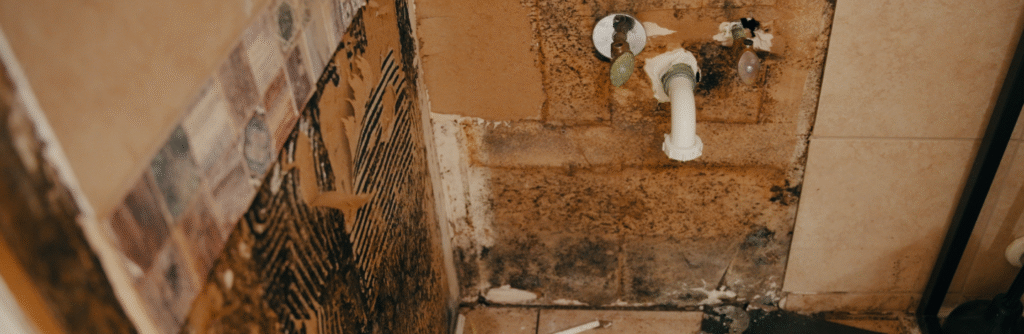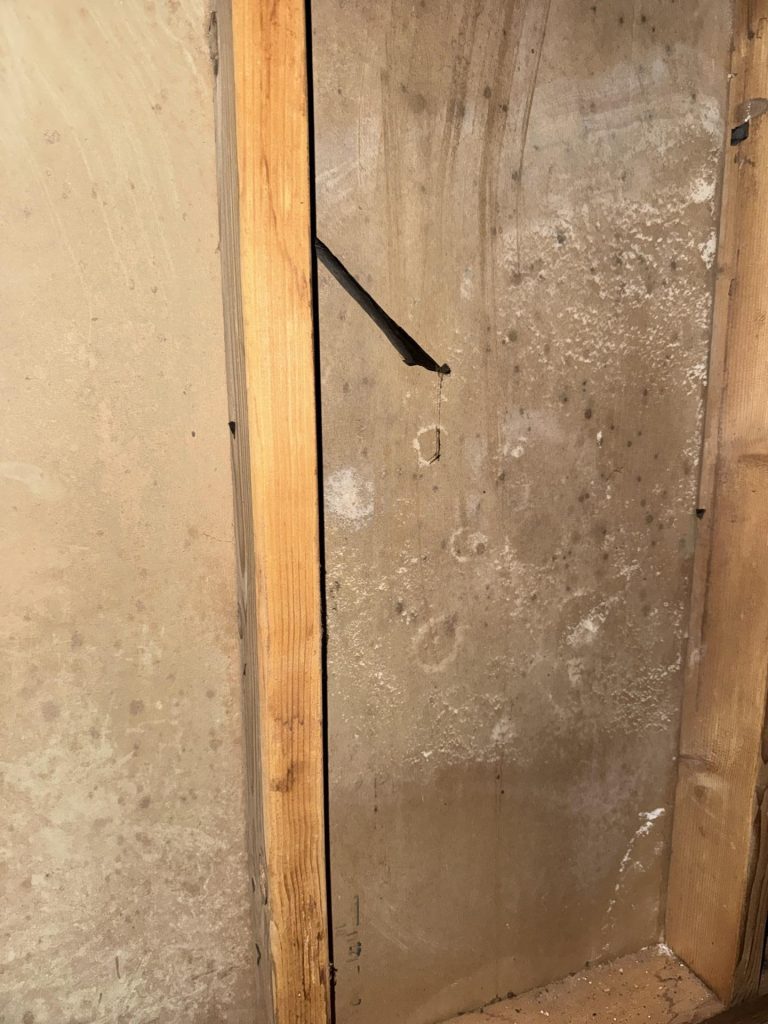
Most people picture mold as something dramatic, visible black patches spreading across a wall or ceiling. A lot of real cases look nothing like that at first. They look more like this: subtle discoloration, some scattered white or powdery buildup on framing, nothing that screams for attention, which is exactly why it often goes unnoticed for a while before anyone takes a closer look.
It’s worth being upfront that not every white or powdery deposit on wood framing is mold. Efflorescence, a mineral deposit left behind as moisture moves through wood or masonry and evaporates, can look similar at a glance, and it’s common enough that a photo like this one genuinely could be either, or some combination of both. That’s not a hedge to avoid saying something firmly, it’s the honest state of what a visual assessment alone can and can’t tell you. Distinguishing between the two, and understanding what a mixed case actually means for a structure, is exactly the kind of judgment a real inspection is built around rather than a guess from a phone photo.
What connects both possibilities is the same underlying story: moisture has been present in this spot for long enough to leave a visible mark, whichever mark that turns out to be. That’s the detail worth sitting with. Staining, discoloration, and mineral buildup don’t show up from a single day of dampness, they build gradually, which means by the time they’re visible, the moisture source behind them has usually been active for a while already, not just started.
A question we hear often: if it’s just a mineral deposit and not mold, is there anything to worry about? Somewhat, yes, even in that case, because efflorescence itself is a visible signal that moisture has been moving through that material, which is worth understanding on its own even before mold enters the picture. Treating a stain as automatically fine because it might not be mold skips the more useful question, which is why moisture reached that spot in the first place, and whether it’s still an active, ongoing condition or something that resolved on its own.
This is also why Ram Mold Pro’s assessments for homes throughout the Dayton, Ohio area don’t stop at a visual look. Moisture readings, and a broader understanding of the space’s history and airflow, are what actually separate “cosmetic mineral staining that’s no longer active” from “early-stage growth on a spot that’s still getting wet,” two very different situations that can look almost identical to the naked eye in a photo like this one.
The practical takeaway isn’t to panic over every discolored board in a crawlspace or wall cavity. It’s to take an ambiguous finding seriously enough to actually resolve the ambiguity, rather than assuming the more comfortable explanation by default. A spot like this is worth a real look specifically because it’s not dramatic yet. The visible, obvious cases rarely need someone to point them out. The quiet ones are where an actual assessment earns its value.
By the numbers:
- Efflorescence and early-stage mold growth can visually resemble one another on wood framing, and distinguishing them typically requires more than a visual inspection alone
- Both efflorescence and mold growth indicate that moisture has been present in a given area over a period of time, not from a single brief event
- Recognized indicators worth a closer look include discoloration on framing members, white or powdery surface deposits, and any staining that doesn’t have an obvious, already-resolved cause
Sources: general building-science guidance on efflorescence versus mold identification; U.S. Environmental Protection Agency, “A Brief Guide to Mold, Moisture, and Your Home”
An ambiguous stain is worth resolving, not guessing at: 888-609-6653 or www.rammoldpro.com