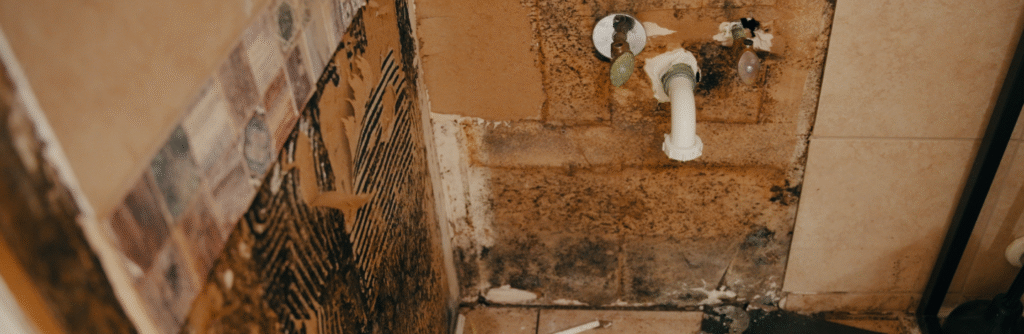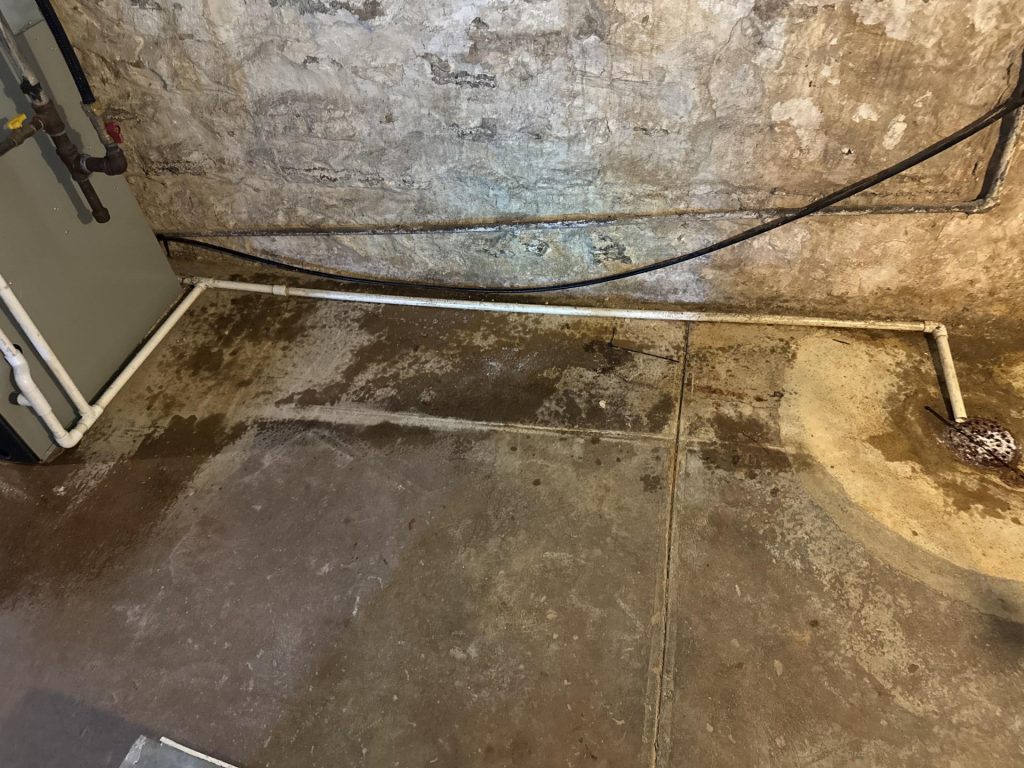
A white, powdery, sometimes crusty coating on a basement or foundation wall gets mistaken for mold more often than almost any other basement finding, and in most cases, it isn’t mold at all, it’s efflorescence.
Efflorescence forms when water moves through concrete or masonry, dissolving mineral salts inside the material, chiefly calcium, as it travels, then evaporates at the surface and leaves those salts behind as a chalky residue. It’s flaky and dry, white to grayish, and unlike mold, it won’t smear when wiped and doesn’t have the fuzzy, spotted texture of an active colony.
But efflorescence is still a signal worth paying attention to, since it’s direct evidence that water is moving through the wall, even if the surface looks dry between rain events. That same moisture pathway is exactly the kind of ongoing dampness that supports mold growth nearby, on cardboard boxes, wood framing, or other organic material stored against that same wall, even though the concrete itself isn’t a food source for mold.
The practical move: if a wall shows efflorescence, it’s worth checking anything porous stored near it, and if the staining keeps returning, addressing the water intrusion itself, grading, drainage, a crack, rather than just brushing off the salt residue each time it reappears.
By the numbers:
- Efflorescence is mineral salt residue left behind as water evaporates from concrete or masonry, not a fungal growth.
- It generally wipes away as a dry, chalky residue, unlike active mold, which typically has a fuzzy or spotted texture and doesn’t brush off cleanly.
- Recurring efflorescence indicates ongoing water movement through a wall, a moisture pathway that can support mold on nearby organic material.
Source: general masonry/concrete industry guidance on efflorescence formation; EPA guidance on moisture control in basements.
If a chalky wall coating keeps coming back, the water behind it is the real question. Call 888-609-6653 or visit www.rammoldpro.com to schedule an assessment.