Most bathroom fans get switched off the moment someone’s done in the bathroom, sometimes even before the mirror clears. That habit feels efficient. It’s also a big part of why bathroom fans, even ones that work fine mechanically, often aren’t actually doing the job they’re there for.
A single shower puts a meaningful amount of moisture into the air in a small, enclosed space, and clearing that moisture takes longer than most people assume. The U.S. Department of Energy’s Building America Solution Center is specific on this point: it’s recommended to leave the fan running for a full hour after a shower for effective humidity control. That’s a longer window than almost anyone actually uses in practice, and it’s exactly why a timer switch, one that runs the fan for a set period and then shuts off automatically, tends to outperform a standard wall switch that depends on someone remembering.
The fan itself also has to be sized correctly to matter at all. The same guidance ties minimum airflow ratings to ASHRAE 62.2 and the International Residential Code, specifically at least 50 cubic feet per minute (CFM) for a fan that runs intermittently, or at least 20 CFM for one designed to run continuously. A fan that’s undersized for the bathroom it’s installed in can run the full recommended hour and still not move enough air to actually bring humidity back down to a reasonable level, which means both the fan size and the run time matter, not just one or the other.
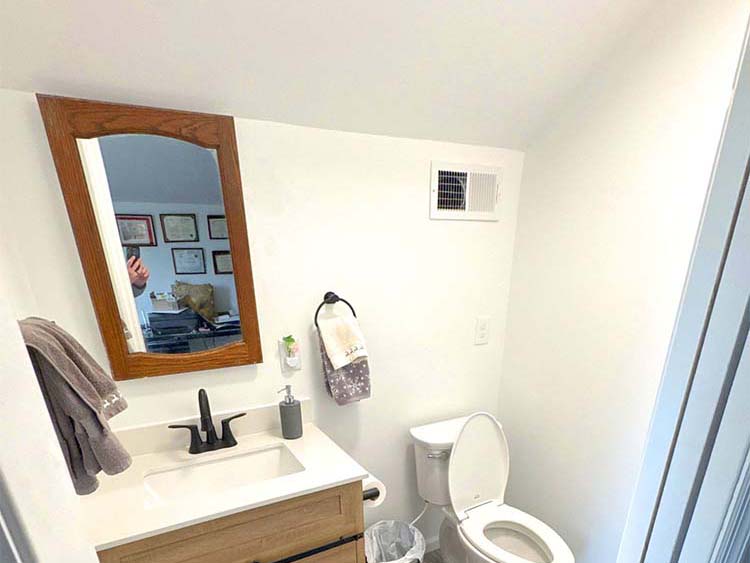
A question we hear often: if the mirror’s clear and the room doesn’t feel steamy anymore, isn’t that a good enough sign the fan’s done its job? Not necessarily. Visible fog clearing from a mirror happens well before the air’s actual moisture content has dropped back to a normal range, since condensation on a cool surface responds to temperature as much as humidity. A room can look and feel dry to a person standing in it while the surrounding wall cavities and ceiling are still absorbing moisture that hasn’t fully cleared the air yet, moisture that a fan like the one pictured here, tucked into a ceiling grille most people walk past without a second glance, is the only thing actually working to remove.
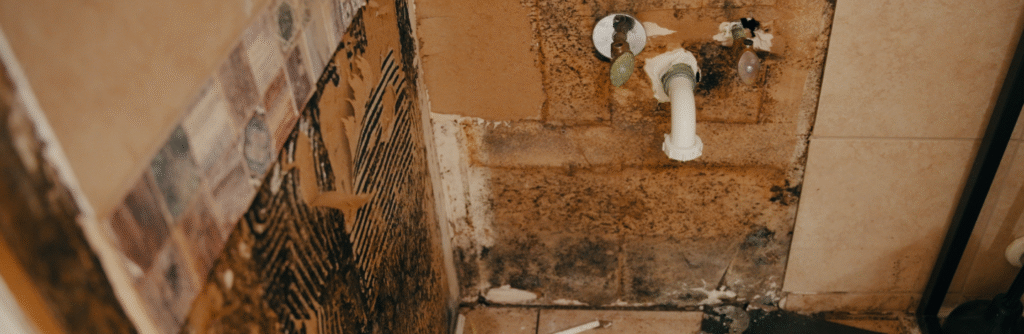
That gap between “looks dry” and “actually cleared” is where repeated exposure adds up over time. A single shower’s worth of extra humidity sitting in a wall cavity for a few extra minutes isn’t the concern on its own. The same pattern repeating daily, for months, in a bathroom where the fan reliably shuts off early, is a very different, cumulative story, one that plays out inside the walls and ceiling long before anyone standing in the room, or glancing up at a grille like the one pictured here, would notice anything had changed.
The fix here doesn’t require a bathroom renovation. It requires either a genuine habit change, leaving the fan on longer than feels necessary, or a timer switch that removes the habit requirement entirely by handling the runtime automatically. Either approach closes the actual gap between how long a fan runs and how long it actually needs to run to matter.
By the numbers:
- The DOE Building America Solution Center recommends running a bathroom exhaust fan for a full hour after a shower for effective humidity control
- Minimum bathroom fan airflow ratings, per ASHRAE 62.2 and the International Residential Code, are at least 50 CFM for intermittent operation or at least 20 CFM for continuous operation
- Visible condensation clearing from a mirror or window is a temperature-driven effect and doesn’t necessarily indicate that a room’s actual humidity has returned to a normal range
Sources: U.S. Department of Energy, Building America Solution Center, bathroom exhaust fan guidance; ASHRAE Standard 62.2
If your bathroom’s had this kind of moisture for a while, it’s worth a real look: 888-609-6653 or www.rammoldpro.com