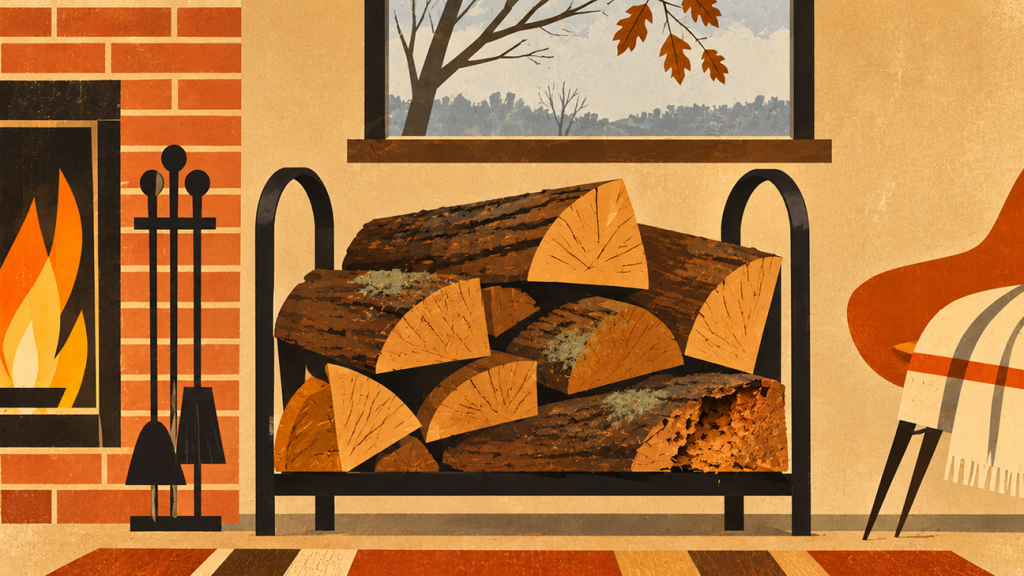
The first cold evening of the season has a way of sending people out to the woodpile. And once the fire is going, it’s tempting to make life easier for next time: stack a good supply in the garage, the basement or a corner of the family room so there’s no trip outside in the dark. It feels practical. But firewood is one of the few things we bring into our homes that is, by its nature, a piece of the outdoors, and where you keep it makes a real difference to the moisture levels inside your house.
Is it a bad idea to store firewood indoors?
Storing a large supply indoors usually is. Keeping a small amount by the fireplace isn’t. University of Illinois Extension recommends bringing firewood inside only as you need it, no more than you’ll burn “within a week.” The rest belongs outside.
There are two reasons. The first is moisture. Wood holds water, and as it dries it releases that water into the air around it. Outdoors, the breeze carries it away. In a basement or closed-up garage, it has nowhere to go. The second is that firewood can carry insects that have been living in it. Illinois Extension notes that insects in the wood can become active and emerge once the wood warms up indoors. They’re generally a nuisance rather than a threat, but it’s one more reason to keep the main stack outside.
How much water is actually in firewood?
More than most people expect. Cornell Cooperative Extension notes that freshly cut, or “green,” wood can have a moisture content of 100 percent or more, which means the water in it can weigh as much as the wood itself. Well-seasoned firewood is very different. The EPA’s Burn Wise program says properly dried firewood should have a moisture content below 20 percent, and that wood should generally be seasoned for at least six months before you burn it.
The gap between those two numbers is water, and it has to go somewhere. If a cord of not-quite-seasoned wood finishes drying in a basement, the basement absorbs that moisture. That’s the same space where many Dayton-area homes are already working to keep humidity in check through the fall.
Can firewood bring mold into the house?
Firewood is organic material that spends its life outdoors, so it’s not unusual for it to have mold on it. The EPA’s guide to mold and moisture in the home even includes a photo captioned “Mold growing outdoors on firewood.” Outdoors, that’s just part of the natural process of wood breaking down.
The concern is less about the wood itself and more about conditions. The EPA notes that the key to mold control is moisture control, and recommends keeping indoor humidity below 60 percent, ideally between 30 and 50 percent. A large woodpile drying out in a closed-up space works against that, especially in a basement or attached garage that’s already cool and damp this time of year. Bring in a week’s worth of dry wood and burn it, and the effect is small. Store the whole winter’s supply indoors, and you’ve added a steady source of moisture to the place where you’d least like one.
What’s the right way to store firewood outside?
The EPA’s Burn Wise guidance is simple and practical, and it lines up with what Extension services recommend:
- Stack wood off the ground, on a rack, pallets or a few rails, so air can move underneath and the bottom layer doesn’t sit in wet soil. Cornell Cooperative Extension suggests pallets as an easy option.
- Cover only the top of the stack. Leave the sides open so air can keep drying the wood.
- Store it outdoors, in a spot that gets sun and wind if you can.
- Don’t stack it right against the house. Illinois Extension advises against piling firewood against the siding, which keeps the wall damp and gives insects an easy path inside.
- Use an inexpensive moisture meter on a freshly split face of a log. Under 20 percent means it’s ready to burn.
What about the garage or a covered porch?
A covered porch or an open-sided woodshed is a good middle ground: the wood stays dry from above while air still moves around it. A closed garage, especially one attached to the house, behaves more like an indoor space. If that’s your only option, keep the supply small, keep it off the floor and away from shared walls, and keep the wood well seasoned before it goes in.
How do you know if your storage habits are affecting your home?
A hygrometer, a small and inexpensive humidity meter, is the easiest way to find out. Put one near where you keep firewood and check it over a couple of weeks. If it regularly reads above 60 percent, the space needs attention, whatever the cause. Other signs worth noticing are condensation on windows or cold surfaces nearby, a musty smell in the basement or garage that wasn’t there in summer, or dampness on the floor under the woodpile.
When is it time to get a professional opinion?
If you’ve stored firewood indoors for years and you’re noticing a persistent musty smell, staining on walls or floors near where the wood was kept, or humidity that stays high even after the wood is moved outside, a professional assessment can give you a clear, measured picture of what’s going on. That might be nothing more than a recommendation to run a dehumidifier. If the moisture turns out to come from a leak or water intrusion, our sister company, Ram Restoration, handles that side of the work.
If the woodpile has lived in the basement or garage and you’d like to know what that’s meant for the space, we’re happy to take a measured look: 888-609-6653 or www.rammoldpro.com
Dealing with water, fire or storm damage? Contact our sister company, Ram Restoration, at www.ramrestorationusa.com/contact/
Related reading
- Why Do Holiday Decorations Smell Musty Coming Out of Storage?
- Why Do Windows Suddenly Start “Sweating” Once Fall Weather Sets In?
- Why Does My Basement Have Mold When There’s No Leak Anywhere?
- All Ram Mold Pro articles
FAQ’s
How much moisture is in freshly cut firewood?
Freshly cut wood can have a moisture content of 100 percent or more (Cornell Cooperative Extension).
How dry should firewood be before you burn it?
The EPA’s Burn Wise program says seasoned firewood should be below 20 percent moisture and dried for at least six months.
How much firewood should you bring inside at once?
University of Illinois Extension recommends bringing in only as much firewood as you’ll burn “within a week.”
What indoor humidity level helps prevent mold?
The EPA recommends keeping indoor humidity below 60 percent, ideally between 30 and 50 percent.
Sources: U.S. Environmental Protection Agency, Burn Wise, “Choose the Right Wood”; University of Illinois Extension, firewood storage guidance; Cornell Cooperative Extension, firewood seasoning guidance; U.S. Environmental Protection Agency, “A Brief Guide to Mold, Moisture and Your Home”