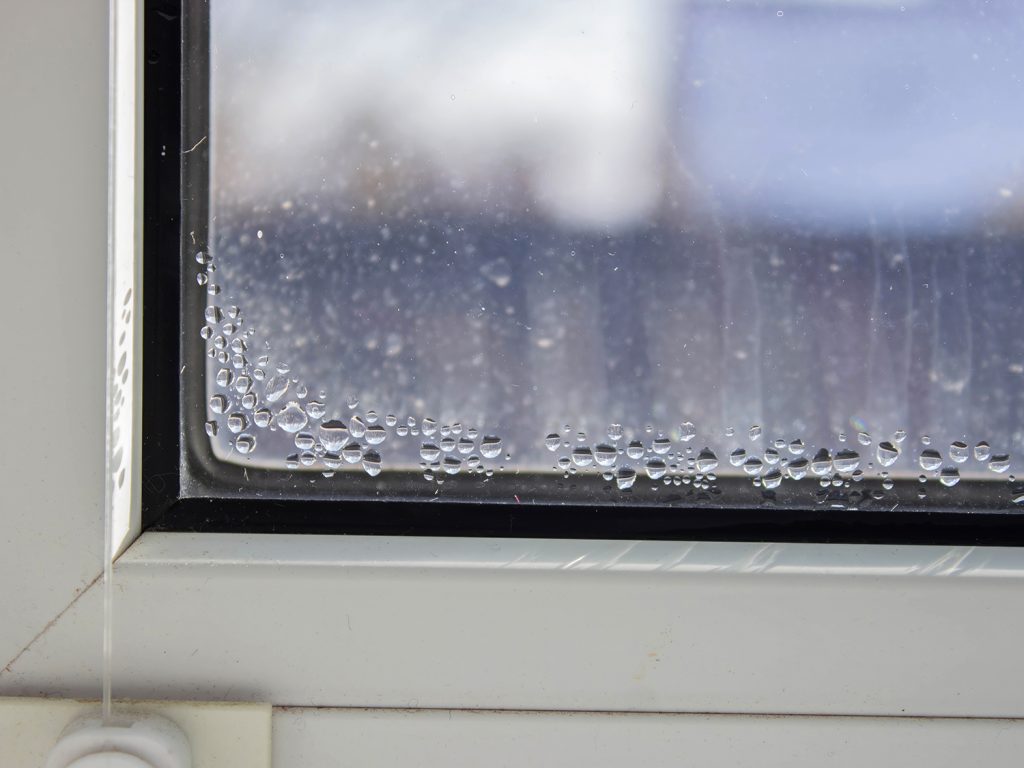
Every fall, the same question shows up: windows that stayed perfectly dry all summer suddenly develop a film of moisture, sometimes enough to pool on the sill. It’s not a sign anything’s broken. It’s basic physics, and Cornell Cooperative Extension’s own explanation of window condensation lays out exactly why it happens this time of year specifically.
What’s actually causing the moisture to show up on the glass?
Cornell’s fact sheet states the mechanism plainly: “Cold air holds less water vapor than warm air, the excess water vapor will condense when the temperature of the air decreases.” Every home’s air carries some amount of water vapor, generated by cooking, showering, breathing, and everyday living. In summer, that vapor stays suspended in the air, since warm air can hold a lot of it. Once a surface gets cold enough, a window in particular, on a cool fall morning, that same vapor hits its dew point and turns back into liquid water on contact with the glass.
Windows are especially vulnerable to this because of a basic materials fact Cornell points out directly: “Glass is a poor insulator,” with a single-pane window rated around R-1 compared to roughly R-11 to R-20 for a typical wall. That gap means a window’s interior surface can sit dramatically colder than the wall around it even when the room itself feels perfectly comfortable, making it the first place condensation shows up even before the rest of the house feels noticeably more humid.
Does this mean something’s actually wrong with the house?
Not necessarily, and that’s part of why it catches people off guard every year. The same fact sheet notes that as heating season sets in and indoor temperatures get managed more tightly, “the air can hold less moisture,” meaning activities that generated a normal, unnoticed amount of humidity all summer can start producing visible condensation once the temperature balance shifts. It’s less that something changed about the house and more that the same year-round humidity is now meeting a colder surface than it was in July.
That said, condensation that shows up consistently, especially pooling enough to reach a windowsill or frame repeatedly, is worth paying attention to rather than wiping away and ignoring all winter. Repeated moisture on wood sills, frames, or nearby drywall is exactly the kind of small, regular exposure that can eventually support growth in a spot most people don’t think to check until it’s already visible.
By the numbers:
- Condensation forms because cold air holds less water vapor than warm air, so excess moisture condenses once air temperature drops, per Cornell Cooperative Extension
- Single-pane glass has an insulating R-value of about 1, versus roughly R-11 to R-20 for a typical wall, making windows the coldest, most condensation-prone surface in a room
- Lower indoor temperatures during heating season reduce how much moisture the air can hold before reaching its dew point
Sources: Cornell Cooperative Extension, “Moisture Condensation at Windows” fact sheet
If a window’s condensation is turning into a recurring puddle, it’s worth a second look: 888-609-6653 or www.rammoldpro.com