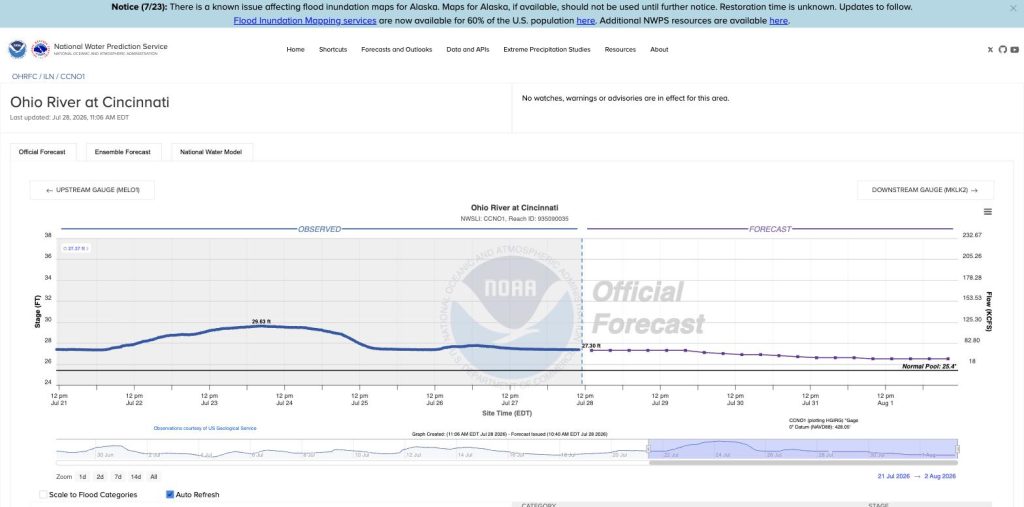
Cincinnati’s East Side wasn’t the only thing responding to two weeks of heavy weather. The Ohio River itself ticked up too, rising from a baseline around 27 feet to a crest of 29.63 feet around July 23 and 24, before receding back down toward 27 feet by the end of the week. That’s well short of the river’s 52-foot flood stage, and there’s no flood watch or warning in effect for Cincinnati as of this week, according to the National Weather Service’s river forecast.
That’s worth saying plainly: this isn’t a flood event on the river itself. But a rise like that, coming on the heels of the July 17 flash flood and the follow-up storm on July 21, is a useful reminder that “the flood is over” and “the ground is dry” aren’t the same statement. Nearly two weeks of repeated heavy rain and a rising river keep soil saturated well beyond what any single storm would do on its own, and saturated soil near a foundation or a river-adjacent basement keeps pushing moisture inward long after the skies clear and the gauge reading looks unremarkable again.
For homes and buildings in low-lying areas along the river corridor, East End, California, Anderson Township, that cumulative saturation is often a better predictor of ongoing basement dampness than whether any single water level crossed a flood threshold. A basement that’s stayed damp through two storms and a river bump, even a modest one, has had more time for mold to establish than a basement that took on water once and then had two dry weeks to recover.
If a basement near the river corridor has stayed damp through more than one round of this month’s weather, the cumulative time wet matters more than whether the river technically flooded. Call 888-609-6653 or visit www.rammoldpro.com to schedule an assessment.
Dealing with water, fire or storm damage? Contact our sister company, Ram Restoration, at www.ramrestorationusa.com/contact/
Related reading
- Cincinnati Just Had Two Flood Events in Two Weeks. Here’s Why Mold Risk Peaks After the Water’s Gone
- It’s Been Over a Week Since Cincinnati’s Flash Flood. Here’s What East Side Homeowners Should Check Now
- Why Crawl Spaces Get Worse, Not Better, Once the Ground Freezes
- All Ram Mold Pro articles
FAQ’s
How high did the Ohio River rise in July 2026?
The Ohio River at Cincinnati rose from a baseline near 27 feet to a crest of 29.63 feet around July 23-24, 2026, well below the river’s 52-foot flood stage.
Were there flood warnings for the Cincinnati gauge?
No flood watches or warnings were in effect for the Cincinnati gauge as of this week, per NWS/NOAA river forecast data.
Can saturated soil cause basement seepage after water recedes?
Soil saturated by repeated rain events can continue pushing groundwater and seepage into a basement for days after any individual water level recedes.
Source: NOAA National Water Prediction Service, Ohio River at Cincinnati gauge (NWSLI: CCNO1); National Weather Service Wilmington, OH