Property managers and landlords hear “address the mold” as general advice constantly, without much specificity about what “addressed” actually means or how bad something has to get before it’s a real problem. The U.S. Department of Housing and Urban Development actually answers that question in concrete terms for HUD-assisted housing, and the standard it uses is worth understanding even for properties outside that specific program, because it’s one of the few places this gets defined in actual numbers rather than general language.
HUD’s National Standards for the Physical Inspection of Real Estate (NSPIRE) sets specific thresholds by square footage. Patches or spots cumulatively under 4 square inches pass inspection. Once cumulative patches exceed 4 square inches but stay under 1 square foot, that’s a fail. Between 1 and 9 square feet is also a fail, and anything beyond 9 square feet is treated as an extremely high-severity fail. Corrections at that point are expected within a defined window, not left open-ended.
What’s useful about a framework like this is that it replaces a subjective “does this look bad” judgment with an actual measured threshold. A property manager walking a unit doesn’t need to guess whether something rises to the level of a real issue, there’s a specific number to check it against, and that number scales meaningfully, a mold patch under 4 square inches is treated very differently than something spanning multiple square feet.
The standard doesn’t stop at visible growth, either. NSPIRE also requires that a bathroom have “an exhaust fan, window, or adequate means of ventilation or dehumidification” that’s actually present and operable, not just installed at some point and left unchecked. A bathroom with a fan that no longer works is treated as a deficiency in its own right, independent of whether visible mold has developed yet, because the standard recognizes inadequate ventilation as the underlying condition that leads to exactly that outcome.
A question we hear often: does this standard apply to every rental property, or just HUD-assisted units specifically? Technically, NSPIRE governs HUD-assisted housing inspections specifically. Practically, it’s a genuinely useful reference point for any rental property owner or property manager, because it represents a real, federally-developed threshold for what counts as a meaningful mold problem versus a minor, easily-addressed spot, rather than each property owner inventing their own informal standard.
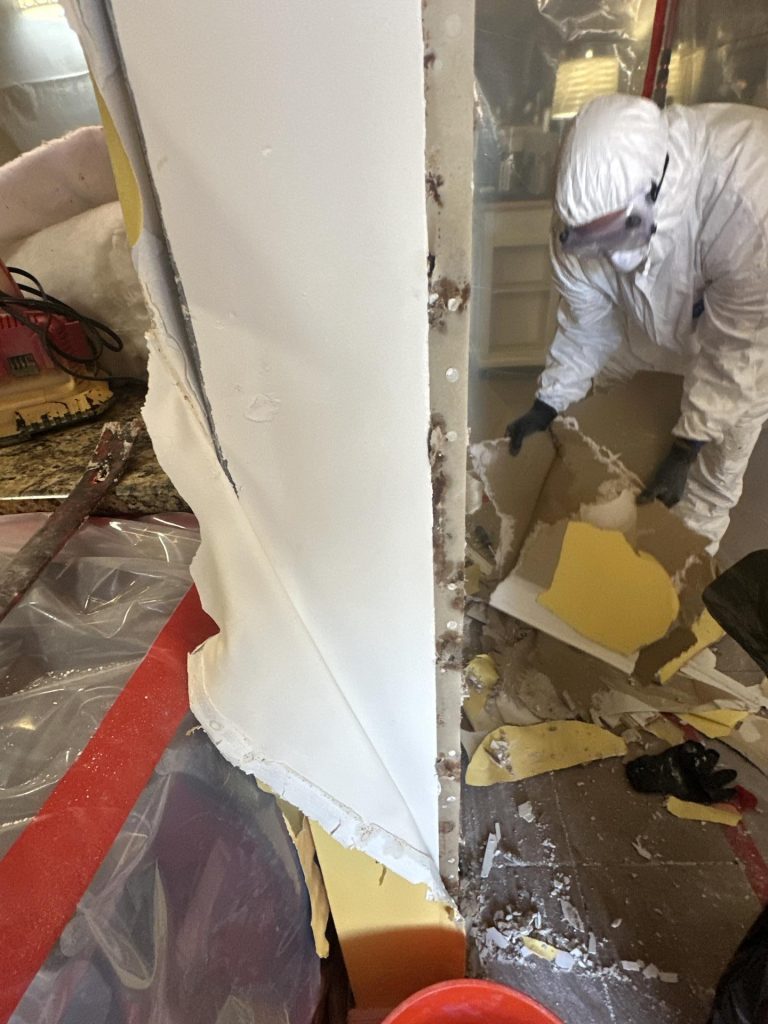
For a remediation project pictured here, full containment, protective equipment, controlled removal, that’s exactly the kind of response a larger, higher-severity finding under a framework like NSPIRE would call for. Smaller findings don’t require that level of response, which is part of why having an actual threshold matters: it helps calibrate the right level of response to the actual severity, rather than either underreacting to something serious or overreacting to something minor.
By the numbers:
- Under HUD’s NSPIRE standard, mold patches cumulatively under 4 square inches pass inspection; beyond that, findings are classified as fails at increasing severity levels up to 9+ square feet
- HUD-assisted housing inspections require corrections for qualifying deficiencies within a defined timeframe rather than an open-ended window
- NSPIRE separately requires bathrooms to have a functioning exhaust fan, window, or adequate ventilation/dehumidification method, treating inadequate ventilation itself as a deficiency
Sources: U.S. Department of Housing and Urban Development, National Standards for the Physical Inspection of Real Estate (NSPIRE), “Mold-like Substance” standard
Managing rental properties in the Dayton area? We can help you get ahead of it: 888-609-6653 or www.rammoldpro.com