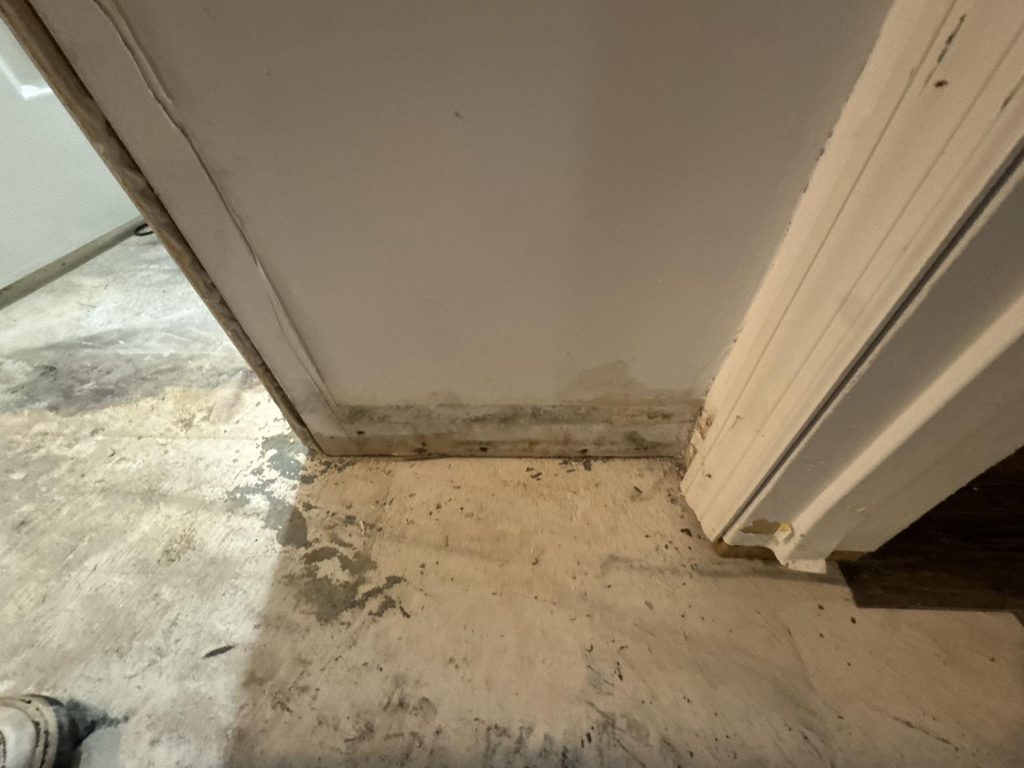
Every winter, a familiar call comes in from homeowners across the Miami Valley: a musty smell in a bedroom closet, a spot on the wall behind a dresser that nobody noticed until the furniture was moved, a corner of a room that always feels a little clammy. In most of these cases there was no leak, no flood and no plumbing problem. The moisture came from the air inside the house, and it collected where the house is coldest and the air moves least.
Why do exterior walls get cold enough to collect moisture?
An exterior wall is the boundary between a warm, lived-in house and a cold Ohio winter. Even a well-insulated wall has an interior surface that runs cooler than the middle of the room, and corners, closets and the wall behind large furniture run coolest of all. The physics is the same one that fogs a cold glass on a summer day. Building-science guidance from the U.S. Department of Energy’s Building America Solution Center puts it plainly: “Condensation can occur on building materials when their surfaces drop below the dewpoint of the air they are exposed to.” In winter, indoor air, warmed and loaded with moisture from cooking, showers, laundry and breathing, is exactly the air that reaches those cold surfaces.
Why are closets and the space behind furniture the usual trouble spots?
Because they combine a cold surface with still air. A closet door that stays shut most of the day, packed with clothing and boxes, keeps warm room air from reaching the back wall, so that wall stays colder than the rest of the room. A dresser, bookcase or headboard pushed flat against an exterior wall does the same thing. The EPA’s guidance on preventing moisture problems gives the two ways to stop condensation: “increasing surface temperature or reducing the moisture level in air (humidity).” It also names the simplest way to raise surface temperature: “insulate or increase air circulation.” A closed closet and a tight-fitting piece of furniture work against both.
Is this the same thing as windows sweating?
It’s a close cousin. Window condensation (covered in our earlier post on why windows sweat in fall) is easy to see because glass is the coldest surface in most rooms and the water shows up right away. Cold walls are different: the moisture is slight, spread out and hidden behind clothes or furniture. That’s why it often goes unnoticed until there’s a smell or a spot. The same building-science guidance notes that moisture from condensation “can quickly lead to mold growth,” and that paper-faced drywall and wood-based materials are especially vulnerable because they provide readily available nutrients.
What indoor humidity level keeps this from happening?
The EPA recommends keeping indoor relative humidity “below 60 percent relative humidity (RH), ideally 30 percent to 50 percent, if possible.” In winter, the lower end of that range is usually easier to hold, and it’s the range that makes cold-surface condensation much less likely, since lower humidity lowers the dew point. A basic digital hygrometer from a hardware store gives a reading in seconds and is worth keeping in a bedroom or basement through the heating season.
What simple habits keep cold corners dry?
- Leave closet doors on exterior walls cracked open, especially overnight, so room air can reach the back wall.
- Pull dressers, bookcases and headboards on exterior walls a few inches away from the wall to leave an air gap.
- Keep stored boxes and clothing off the floor and a little away from exterior walls in closets and basements.
- Run bathroom and kitchen exhaust fans to send cooking and shower moisture outside rather than into the rest of the house.
- Check the hygrometer occasionally and aim for 30 to 50 percent.
- When you rearrange a room or change out seasonal clothes, take a quick look at the wall and baseboard behind what you moved.
What should you do if you find a spot or a musty smell?
Look first, and don’t panic. A small amount of surface discoloration on a cold wall usually points to a humidity and airflow problem that the habits above can address. The EPA’s guidance is to clean and dry damp spots within 48 hours and to fix the moisture source promptly. If the area is larger, keeps coming back after it’s been cleaned, or there’s a persistent musty odor with no obvious source, that’s when a professional assessment makes sense: measuring moisture in the wall itself, checking humidity and airflow in the room, and finding out whether something else is contributing.
Why does this matter more in a Dayton winter?
Miami Valley winters bring long stretches below freezing, so exterior walls stay cold for weeks at a time rather than for a night or two. That’s long enough for small, repeated condensation to add up. The good news is that the fixes are simple, cost almost nothing and take a few minutes, and most homes never need more than that.
If a cold corner or closet keeps smelling musty no matter what you try, we’re glad to take a closer look: 888-609-6653 or www.rammoldpro.com
Dealing with water, fire or storm damage? Contact our sister company, Ram Restoration, at www.ramrestorationusa.com/contact/
Related reading
- Does Closing Your Windows for the Season Quietly Raise Your Indoor Mold Risk?
- Why Do Holiday Decorations Smell Musty Coming Out of Storage?
- Why Do Windows Suddenly Start “Sweating” Once Fall Weather Sets In?
- All Ram Mold Pro articles
FAQ’s
Why does condensation form on cold walls?
Condensation forms when a surface drops below the dew point of the air around it, per the U.S. Department of Energy’s Building America Solution Center.
What indoor humidity level helps prevent mold?
The EPA recommends indoor relative humidity below 60 percent, ideally 30 to 50 percent.
How quickly should damp spots be dried?
The EPA advises cleaning and drying damp or wet spots within 48 hours.
Sources: U.S. Department of Energy, Building America Solution Center (Pacific Northwest National Laboratory), “Condensation Control: Walls, Cold Weather”; U.S. Environmental Protection Agency, “Mold Remediation in Schools and Commercial Buildings Guide: Chapter 2” and Mold Course Chapter 9, “Prevention”