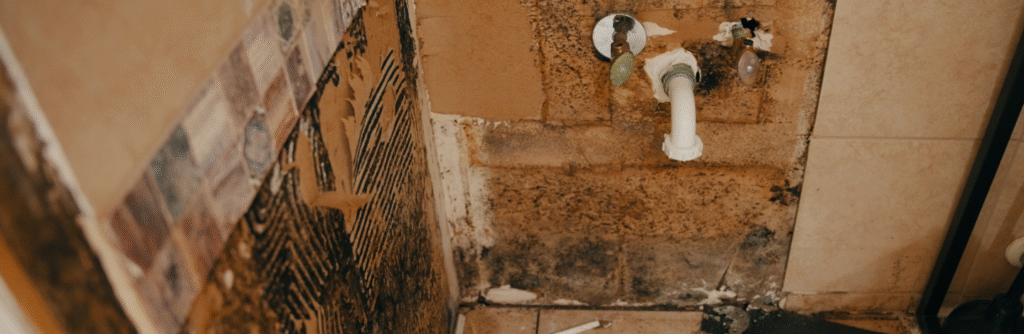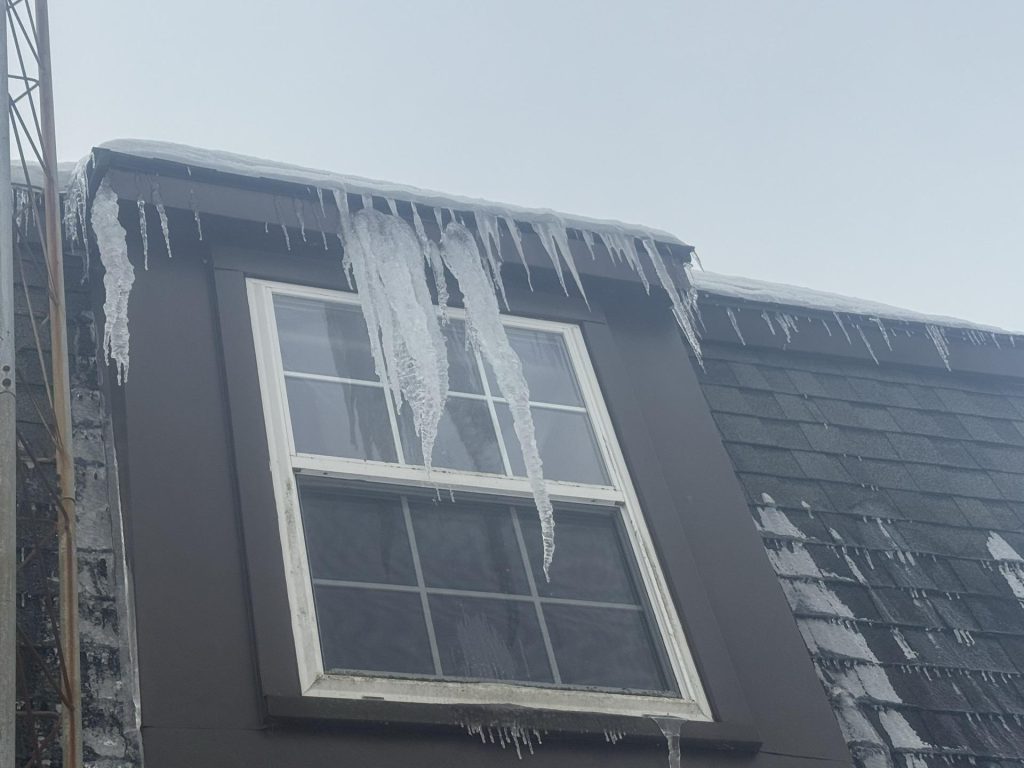
The icicles are gone, the gutters are flowing again and the brown ring on the bedroom ceiling has stopped growing. It is tempting to call the ice dam a closed chapter. But the stain you can see is often only the visible end of a longer path the water took, and some of that path runs through places you cannot see: attic insulation, the top of an exterior wall, the space between drywall and sheathing.
Here is what happens after an ice dam, where moisture tends to hide and what to do so a one-time leak does not become a long-term moisture problem.
What actually causes an ice dam?
The University of Minnesota Extension explains it simply: “Heat loss from a house, snow cover and outside temperatures interact to form ice dams.” Warm air escaping into the attic heats the upper roof above 32 F while the eaves stay below freezing. Snow melts higher up, runs down and refreezes at the edge, building a ridge of ice. Water then pools behind that ridge with nowhere to go.
How does the water get from the roof into the walls?
Shingles are built to shed water running downhill, not to hold back standing water. According to UMN Extension, backed-up water “finds cracks and openings in the exterior roof covering and flows into the attic space.” From there, “it could flow into exterior walls or through the ceiling insulation and stain the ceiling finish.”
That is the key point. A ceiling stain tells you water reached the drywall. It does not tell you how much soaked into the insulation above it or ran down inside the wall below the eave.
Why can insulation and wall cavities stay damp for weeks?
Wall cavities and attic floors are built to slow air movement, which also slows drying. Wet fiberglass or cellulose can hold water against framing and drywall. In winter, the outer side of an exterior wall stays cold, and the U.S. Department of Energy’s Building America Solution Center notes that materials such as oriented strand board (OSB) sheathing and paper-faced gypsum board are especially vulnerable to moisture. A cold, enclosed, slow-drying space is exactly where dampness lingers.
The U.S. Environmental Protection Agency’s guidance is direct: “Clean and dry wet or damp spots within 48 hours.” The longer materials stay wet, the more the chance of mold growth increases.
What should you look for after the thaw?
Most clues show up in the rooms right under the roof edge and along exterior walls:
- Ceiling stains, especially near outside walls or in corners
- Peeling or bubbling paint or wallpaper on the upper part of exterior walls
- Swollen or separating baseboard or window trim on second-floor rooms
- A musty smell in an upstairs closet or a room that was not musty before
- Damp, matted or discolored insulation if you can safely see into the attic
- Frost or dark spots on the underside of the roof deck
None of these means you have a mold problem. They mean moisture got somewhere it should not be, and it is worth checking how far it went.
Is it safe to just paint over the stain?
Not yet. UMN Extension advises, “Do not repair interior damage until ceilings and walls are dry.” Painting or patching over damp material traps the moisture behind a fresh surface. The stain may come back, and the cavity behind it has even less chance to dry.
The same source adds that “interior repair should be done together with correcting the heat loss problem.” If warm air keeps leaking into the attic, the next snowfall can build the next ice dam in the same spot.
Who handles the drying, and who checks for mold?
These are two different jobs, and they work best in order.
If water is actively coming in, or ceilings, walls or insulation are wet, that is a water damage job. Our sister company, Ram Restoration, handles water extraction, structural drying and removal of saturated materials. Getting that done quickly matters, because EPA guidance is to dry wet materials within 48 hours.
Once the area is dry, or if the leak happened weeks ago and you are not sure what is still inside the wall, that is where Ram Mold Pro comes in. We use moisture meters and thermal imaging to find damp areas behind surfaces, inspect the attic and wall areas in the path of the leak and tell you plainly whether there is mold growth to address. If there is, we explain what remediation involves. If there is not, we tell you that too.
How do you keep it from happening again?
UMN Extension notes that a contractor can use a blower door test, and sometimes an infrared camera, to locate where warm air is escaping into the attic. Sealing those leaks and adding insulation where it is thin reduces the heat that melts roof snow in the first place.
Inside the house, keep winter humidity in check. EPA recommends indoor relative humidity below 60 percent, ideally between 30 and 50 percent. Lower indoor humidity means less moisture riding along with the warm air that escapes into the attic.
Why does this matter in the Miami Valley?
Dayton winters swing above and below freezing, often several times in a week. Every freeze-thaw cycle with snow on the roof is a chance for meltwater to back up at the eaves. Homes with older insulation, recessed lights in top-floor ceilings or unsealed attic hatches are the most likely to see repeat ice dams, and repeat leaks into the same wall or ceiling are the most likely to cause lasting moisture problems.
Had an ice dam this season and not sure what is left inside the walls? Call Ram Mold Pro for a moisture and mold assessment: 888-609-6653 or www.rammoldpro.com
Dealing with water, fire or storm damage? Contact our sister company, Ram Restoration, at www.ramrestorationusa.com/contact/
Related reading
- Does Mold Risk Actually Go Down Once The Weather Turns Cooler?
- How Long After Rain Does Mold Actually Start Growing In Your Dayton Home?
- Why Do Holiday Decorations Smell Musty Coming Out of Storage?
- All Ram Mold Pro articles
FAQ’s
How do ice dams form?
32 F: Ice dams form when the upper roof is above freezing and the eaves are below it (University of Minnesota Extension).
How quickly do wet materials need to be dried after an ice dam leak?
48 hours: EPA guidance for cleaning and drying wet or damp materials.
What indoor humidity level helps prevent mold?
30 to 50 percent: The ideal indoor relative humidity range recommended by EPA; keep it below 60 percent.
Sources: University of Minnesota Extension, “Dealing with and preventing ice dams”; U.S. Environmental Protection Agency, “Mold Remediation in Schools and Commercial Buildings Guide: Chapter 2”; U.S. Department of Energy, Building America Solution Center (Pacific Northwest National Laboratory), “Condensation Control: Walls, Cold Weather”